Tuesday, February 1, 2011

Juneuary 1/21-23, 1/28-29

January has been a rough month for California skiing. There has been essentially no snow from New Year's day until January 30th, when a storm finally snuck into the region behind the back of the persistent ridge off the West Coast. I'll leave it to the weather bloggers to discuss why it has been so dry and why it will continue for at least the next 10 days. We've been making the best of the Spring-like conditions: crusing the groomers, the park, semi-soft/semi-ice bumps, and hiking around a bit.

Friday and Saturday (1/21 and 1/22) were nice and warm. Saturday we left Kirkwood early and Owen, Jen and I hiked above Caples Lake to have lunch and build a little jump to play around on.

Saturday 1/22: Jump above Caples Lake
 

Troy

Crashing


Troy 3

Bringing back the '90s


Sunday was less warm, and nothing ever really softened. It did remind me of ice-sliding on the East Coast though, so that was nostalgic.
Sunday 1/23: Cold and icy at Kirkwood.
The next weekend Owen and I headed back up for more spring skiing, this time with a new wide-angle camera:
We headed back to Caples Lake, this time being a little more ambitious in our jump construction:

It was perhaps a little bit too big for our jumping skill set, but we made the best of it, and had a really nice sunset...


Finally, I had a good time experimenting with the timelapse features of the new camera. Click the "vimeo" link to watch in HD.


Thursday, January 13, 2011

Learning about avalanches 1/8

Owen and I have been talking about getting into the backcountry over the past year and of course, a key part of the backcountry is avalanche safety. So, in addition to acquiring the basic gear (transciever, probe, shovel), we also took an introductory course at Kirkwood this past Saturday.


Kirkwood offers a series of avalanche courses; this one was the most basic, with a couple hours in the classroom, about an hour using equipment in the snow, and another hour+ on the slopes. The more advanced courses (AAIRE level 1 and AAIRE level 2) are 3 days and 4 days each, and really get into the details of evaluating avalanche danger and trip planning. This course was meant to be an introduction to a lot of the information in the more advanced courses, focusing on being aware of the dangers and warning signs and how to use the equipment to perform a rescue. However, they managed to provide a base of terminology knowlege that will be really useful when reading more in depth info. The Sierra Avalanche Center provides a lot of useful information based on in-the-field observations of snowpack. Having some basic terminology helps in reading the reports and getting a better feel for what snow conditions present what dangers.

Headline report from the SAC. Conditions are quite safe right now, due to lack of recent snowfall.

 We did a real-life scenario where the instructors had pre-buried avalanche beacons. Without telling us ahead of time, we suddenly had to locate and dig up the beacon. It was a great experience to have something a little closer to what a real-life scenario might be like. Owen and I are looking to take the level 1 course for a more complete understanding.

Snow-wise, it was a good day to be spending time in the classroom since it hadn't snowed in the past week. We got a run in before the clinic and then five more after. Even though there wasn't any powder, the snow was actually quite good in places, mainly because it has been so cold and the January sun hits the snow for only a short period of time during the day.


The bumps under the liftline and on Olympic were good, at least by Kirkwood standards. That means there would be maybe 5 turns in a row before you had to change lines.

Looking forward, Northern California looks to stay in a storm drought for at least the next week. After the crazy November and December we had, we're having a really dry January. Right now, the Jet stream is focused to our North, pushing storms into the Pacific Northwest. However, there's hope that things will turn around for at least the last week of the month and the storm door will open again for us.

Tuesday, January 4, 2011

New Year's 12/31 - 1/1

We drove up to Kirkwood on the morning of New Year's Eve. Since the last time we were up two weeks ago several more storms had come through. Since Christmas alone there's been another four feet, and Kirkwood reports 340 inches so far this season, almost entirely in the last 40 days. There's more snow on the ground than I've seen in any of the past 3 seasons.


88 East to Kirkwood 12/31/2010 from Kyle on Vimeo.


Lauren and I skied with Owen on Friday, New Year's Eve. The previous day was a powder day, so the snow was quite good and there were still fresh tracks to be had with a little bit of a hike. Despite having a fairly bad cold, Owen convinced me to hike far out in the Palisades. As usual though, it was totally worth it.

Looking back on Kirkwood.
That night we stayed in a cabin off the grid, a half mile snowshoe in from the road across from Kirkwood. I got to try out my skins, which worked well but are a little slower less manouverable than snowshoes.

Ready for the hike in.

Approaching the cabin, alongside the lake.
Snow up to the second story of the cabin.
Owen snowboarded off the roof the night we got there.
The wood-burning stove actually did heat up the place a bit.

Lauren, fully bundled.

I wasn't the happiest camper the next morning...
It had snowed another 6 inches or so by New Year's morning, making for a solid powder day. I woke up pretty sick after a cold night in the cabin, but after some drugs and food, I managed to suck it up and ski some powder.

Tuesday, December 28, 2010

Skiing the East 12/27

Yesterday my sister Jenna and I skied at Gunstock, NH. Gunstock is a relatively small, family-oriented ski area about an hour from our house, where all the trails and lifts are named after guns or gun-related paraphenalia. It is also where we both learned to ski in the 90s. Skiing in the east is sometimes something that can only be appreciated by those who grew up skiing here, and occasionally not even by those people. 

The snow was relatively cooperative yesterday: We got a classic "Nor' Easter" that gave Gunstock close to a foot of snow (and two feet at some of the more Northern areas). Unfortunately, it fell on top of manmade-only snow, recognized by skiers from Western states as "ice." Still, a good amount of the snow managed to stay on the trails instead of being blown off into the woods. While it wasn't a "powder day" in any sense of the word I'm now accustomed to, it made for pretty decent surface conditions.

Looking down on Lake Winnipesaukee from the summit. Gunstock's snowmaking team hadn't yet got to the right half of this trail.
In the 90s, and probably now also, this "trail", Tiger Steeps, was usually the only spot on the mountain left ungroomed. I remember it as a near-vertical face of sedan-size moguls. It is slightly less intimidating now.
New England breeds great park skiers because most of the time, there's really not much else to do. A 14 year old skied past me and did a front flip off the first jump here.
Ice frost on the chairlift bar.
Jenna, learning to snowboard.

By about 2pm we were cold enough that we were ready to call it a day. Ah, New England!
It isn't apparent in the picture, but we are freezing.

It was windy during the day. We could tell because all the snow had retreated to one side of the car by the end of the day.

Monday, December 20, 2010

Sierra Cement 12/17-19

California is in the midst of an epic storm cycle, with ample moisture being drawn up from southern latitudes. On Thursday, this was the forecast liquid precipitation over the next five days:

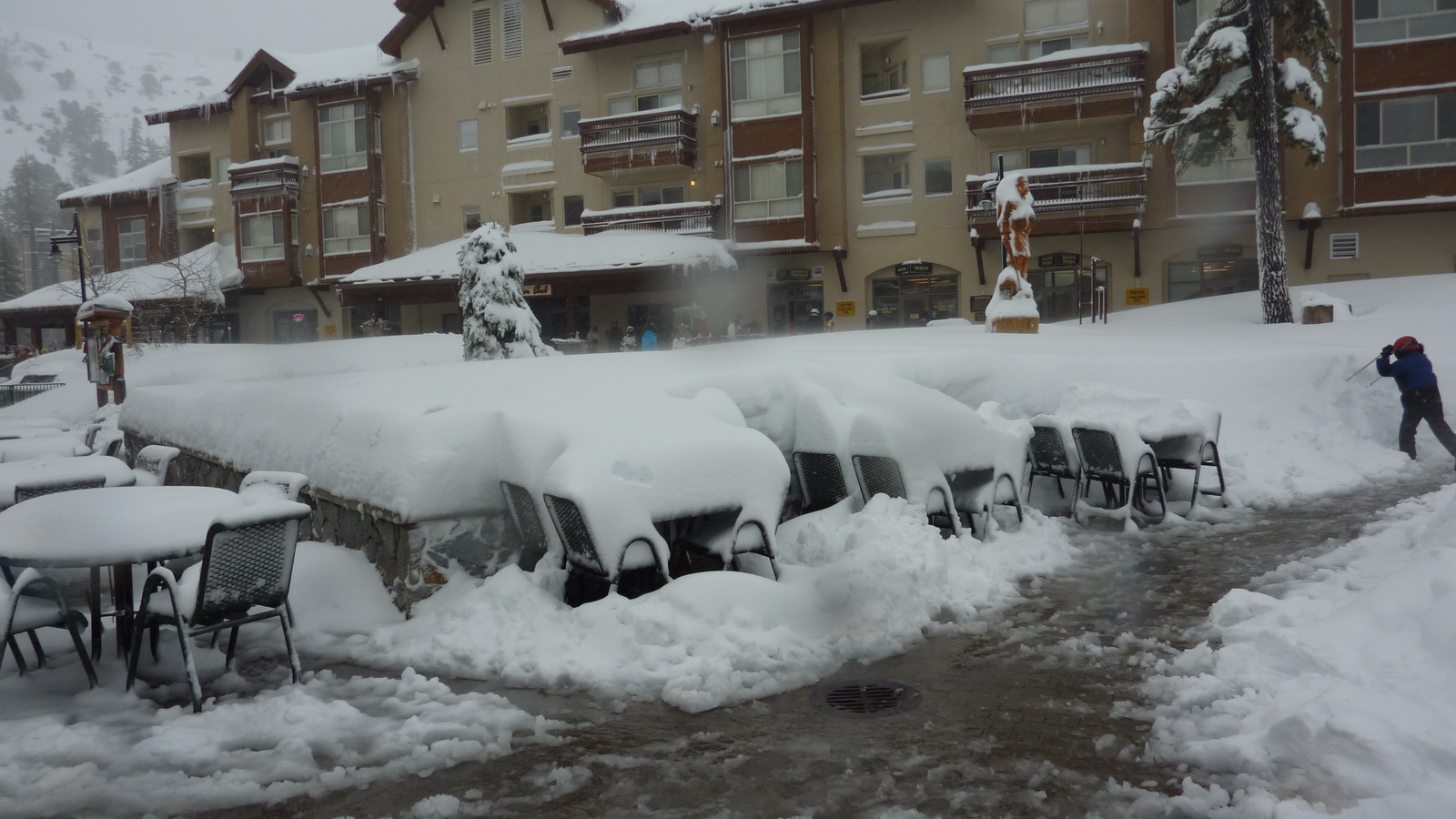
Typically, we would see snow ratios of 12 to 1, meaning that those 15 inches of liquid would translate to 15 feet of snow. However, because of the southern moisture tap, these storms that started Friday have been associated with warmer air and high snow levels.  Snow started Friday morning with snow levels around 6000 feet, resulting in fairly heavy snow at Kirkwood (7800 feet), but not unusual for the Sierras. It snowed steadily throughout the day, resulting in a pretty fun powder day.

Friday, we randomly ran into our roommate Justin at lunch and skied the second half of the day together.


Saturday and Sunday snow intensified and snow levels hovered around 7000 feet to 7500 feet. On Saturday the snow was the heaviest I've ever skied. Despite Kirkwood getting multiple feet of the stuff, you would only sink in a few inches. Make a turn a little wrong and it would grab your skis, resulting in a person size divot in the thick snow. Saturday only two chairs were open, but we had a lot of fun, especially after meeting up with a bunch of former cyclists, also randomly run-into.

By Sunday morning, Kirkwood had gotten about 4 feet of heavy, barely-snow, and the storm was intensifying. Around 930 they opened chair 5 for about thirty minutes befure shutting it back down due to wind. We weren't too disappointed in the wind hold: the snow was even heavier and harder to ski than Saturday.
 
Sunday morning. Buried car.


Ski patrol pow-wow. "Should we just tell everyone to go home?"
Kam, Aurora and Liz had driven up to South Lake Saturday night, then to Kirkwood Sunday morning. They did one run, then got stuck driving all the way around the lake to 80. Sorry guys!
13+ hours in the car; 1 run.

Friday, December 10, 2010

Core Shot Repair

In the first two days of the season at Kirkwood, I managed to put 3 core shots in my new skis (the first half of the first day) and 2 core shots in my old skis (day number two). For the uninitiated, a "core shot" is a gouge in the base of your ski that goes completely through the base material, so that the core of the ski is showing. Typically, base gouges are filled by melting additional base material ("P-tex") into the gouge. A core shot is harder to repair than a gouge that doesn't penetrate to the core because P-tex binds well to the base material and itself, but not to the ski core or metal edges. So, if you simply fill a core shot with P-tex, it is likely to rip out.


The bases on the Armada JJs are extremely thin, especially further toward the tips and tails.


Bases of old skis (Head Mojo 90s) are already pretty torn up.

Core shots can be fixed by either putting down a primer layer under the P-tex that will stick to the core material (such as epoxy) or by cutting out the affected area, and replacing it with a patch of new base material. My local ski shop (Cal. Ski Company) will do one of these for $15 per core shot, plus the cost of a regular ski tune (around $50) to smooth out, restructure, and wax the entire base after the repair. With my two pairs of skis and six core shots (including one from last season), this would cost close to $200. While Cal. Ski Co. do excellent work, a full ski tune is overkill for the kind of skiing I do. I'm really only concerned with not having giant holes in my skis; I don't really need (or notice) a full ski tune. Skiing in soft snow most of the time, it is not that important to have a fast base or freshly sharpened edges. I figured that it would be worthwhile for me to buy the equipment I need and learn to do the repairs myself. After all, my time isn't worth that much.  Plus, with the equipment in hand, I won't have to look at future encounters with rocks as a $100 day of skiing.

After reading about repair options and watching instructional videos online, I ordered the basic tools I needed to do the minimal repair. This includes a flat-tip soldering iron, base material, base cleaner (with wax remover), a metal scraper, and a panzer file for removing excess material. I decided to try a "primer" material called metal grip. This has a heat-activated adhesive and sticks to the ski core and to the metal edges. All in all, everything was about $100.

The basic steps are (1) Clean hole of rocks, remove wax from base in surrounding area, to aid adhesion. (2) Melt metal grip into the hole, let cool, scrape off to below the surface. (3) Melt base material on top of metal grip, let cool, scrape flat.

Area cleaned, metal grip applied.

After the metal grip cools it becomes rubbery.

Base material on top of metal grip.

After scraping excess base material and filing flush with base.

Older core shot re-repaired.


In places, the bases of the JJs are thinner than my fingernail and this made the repair much more difficult. It is hard to apply the metal grip thinly enough so that it remains below the surface of the base in all places. One can apply excess metal grip and then remove to below the base, but its even more difficult to do this without ripping all the material out. In the end I managed to scrape a very thin layer on with the soldering iron and then remove excess with an exact-o knife without pulling too much away from the base.


A thin layer of metal grip.

Finished product.